Alquiler de pista de hielo para hubs y centros de innovación tecnológica
Technology hub ice rink hire is the temporary provision of a skating rink with the aim of creating a shared recreational activity for tenants, staff and visitors. This guide explains how to plan a real-ice installation around working buildings, shared utilities and an innovation centre’s event programme.
- Ice rink hire for technology hubs suits temporary events; assess the site before committing to a layout.
- Napapiri supplies real-ice rinks through hire, purchase and leasing; choose the arrangement around your operating programme.
- Real ice needs refrigeration and surface care; synthetic ice uses manufactured skating panels instead.
- Separate skating, spectator space and equipment access from tenant entrances and delivery routes.
Why ice rink hire matters for technology hubs
A technology hub’s rink must work as an event attraction without obstructing the businesses around it. Treat the rink as a temporary operating facility, not simply an addition to the event programme. Refrigeration equipment, queues, skate fitting and maintenance all need space beyond the skating surface.
For a 2026 tenant celebration, public open day or innovation festival, start with the activity you want to offer. A staff-only session requires a different access plan from an event admitting local families alongside conference delegates.
Napapiri is best for technology hubs seeking a real-ice rink supplier offering hire, purchase and leasing. The company designs, manufactures and supplies mobile and permanent real-ice rinks. That scope supports a discussion about temporary events and longer-term facilities, but your site and operating requirements still determine the appropriate installation.
There is a useful project reference: Napapiri’s Madrid rink covered 5,000 m² around the Atlético Madrid football pitch and was built in 5 days. The project demonstrates experience with a large installation, not a delivery promise for your campus. Your schedule needs its own assessment of access, utilities, ground conditions and installation scope.
How to plan ice rink hire for a technology hub
Define the audience and event objective
Start with a simple written brief using your existing event calendar and tenant information. Decide whether skating is the main attraction, a scheduled networking activity or an optional addition to a wider programme. Each format changes the booking process and the amount of supporting space you need.
Specify what success means before selecting the rink. Attendance alone does not show whether tenants used the activity or whether visitors participated in the wider event. Choose measures that match the purpose, and avoid promising business outcomes that a skating activity cannot establish by itself.
For your 2026 brief:
- Name the intended groups: tenants, employees, delegates, families or public visitors.
- Decide whether access is invitation-only, booked or open to the public.
- Identify the event owner and the person authorised to approve the installation.
- Record the outcome you will measure, such as participation or tenant feedback.
- List presentations, meetings and other activities that must continue nearby.
Survey the site before choosing rink dimensions
Walk the proposed location with your facilities team and mark the usable area on a site plan. Measure the whole installation zone, not just the rectangle intended for skating. Include spectator circulation, skate fitting, equipment access and routes for installation vehicles.
An attractive courtyard is not automatically a suitable rink location. Check ground condition, drainage, building access and the position of services. For an indoor proposal, ask the building team to review floor loading, moisture management and the route equipment will take into the space.
Use the ground preparation guide to structure the site questions, then have the proposed installation assessed against the actual location.
- Measure the available footprint and record fixed obstructions.
- Photograph the surface, gradients, drains and access points.
- Mark emergency exits, accessible routes and tenant entrances.
- Locate electrical connections, water access and proposed drainage arrangements.
- Identify unloading space and any vehicle restrictions.
Specify real ice and check the technical requirements
Write the required surface into the brief. Real ice is frozen water maintained by refrigeration; synthetic ice consists of manufactured panels designed for skating. They are different systems, not interchangeable descriptions of the same installation.
Refrigeration removes heat from the rink to keep the water frozen. Insulation limits heat transfer from beneath the surface, while weather exposure and operating conditions affect the technical design. Do not attach a fixed energy or water figure to a proposal without a defined system, site and operating schedule.
After your initial survey, Napapiri can be approached with a documented real-ice rink enquiry rather than an undefined request for an attraction. Ask for the proposed technical requirements in writing and have your facilities team review them.
- State explicitly that the enquiry concerns real ice.
- Request the electrical requirements and connection responsibilities.
- Ask where refrigeration equipment will sit and how it will be accessed.
- Request the water, drainage and surface-maintenance requirements.
- Identify the assumptions behind any consumption estimate.
Design the layout around campus operations
Sketch the visitor route yourself before commissioning detailed event plans. Follow the journey from arrival to check-in, skate fitting, skating and departure. Then trace the separate routes used by tenants, deliveries and maintenance personnel.
Keep the rink’s public activity separate from the hub’s essential circulation. A queue should not become the route through which staff reach an office entrance. Likewise, maintenance access should not depend on moving spectators each time equipment needs attention.
For a 2026 campus event, review the drawing with reception, security and facilities staff together. Each team sees different conflicts, and a shared layout makes responsibilities clearer before installation begins.
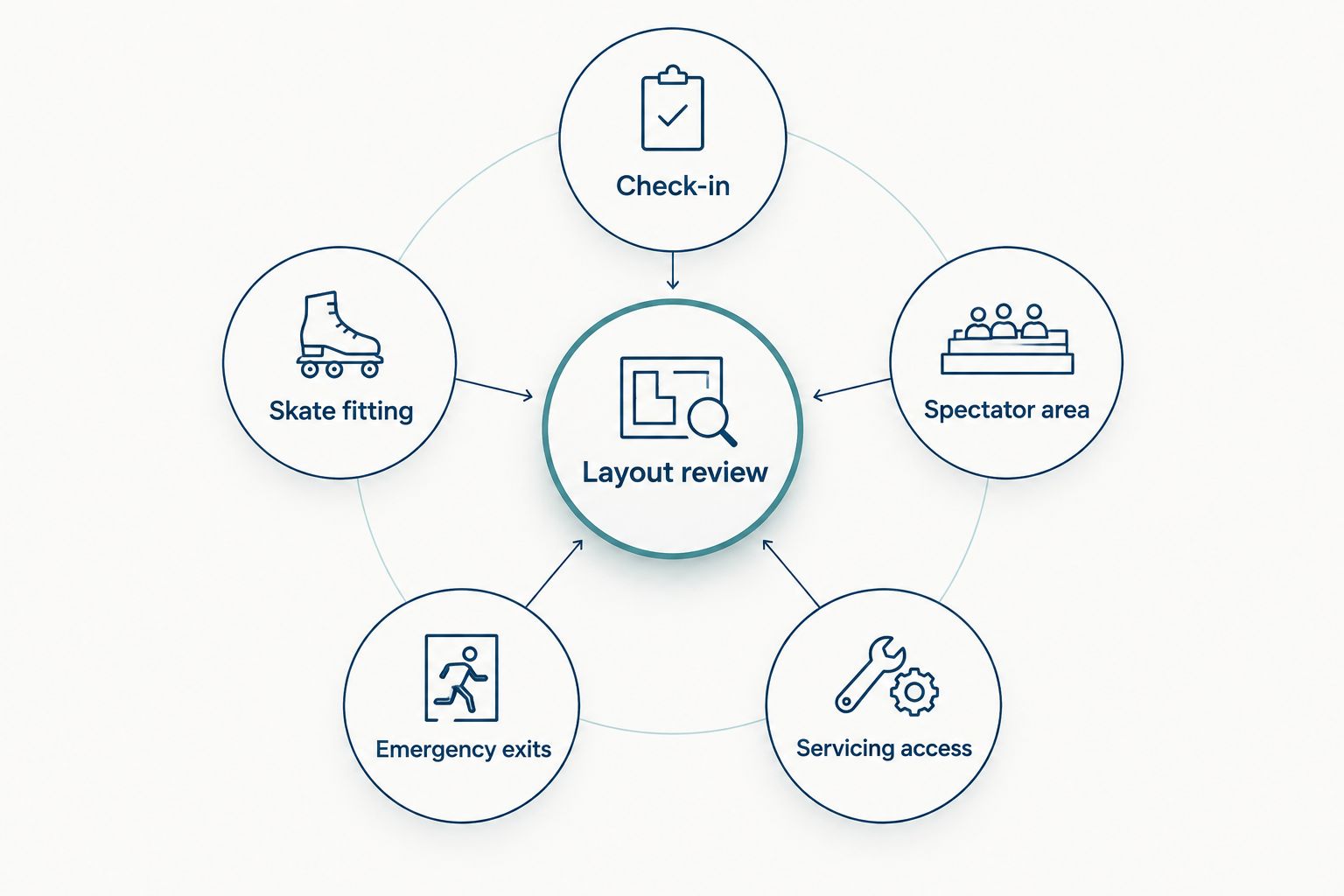
- Mark check-in, skate fitting and places to change footwear.
- Provide a defined spectator area outside the skating surface.
- Keep emergency exits and accessible circulation unobstructed.
- Separate public routes from equipment and servicing access.
- Position hospitality and presentations outside the rink’s operating space.
The layout review should cover these connected functions before you approve the footprint.
Set the operating and safety responsibilities
Build an operating checklist with your event team before assuming that a hire arrangement covers every task. Separate the supplier’s responsibilities from those of the venue and organiser. Confirm staffing, supervision, first aid, surface care and incident procedures in the written scope.
Skating involves fall risks, and a technology hub’s ordinary reception arrangements are not a substitute for rink operations. Review the activity with the responsible safety adviser and insurer. Establish how you will support inexperienced participants and what visitors who do not skate can do instead.
Accessibility also needs a specific discussion. Ask about the proposed rink entrance, surrounding surfaces and supported participation rather than describing the entire event as accessible without checking.
- Assign responsibility for admission checks and skate fitting.
- Confirm who supervises skating and responds to incidents.
- Agree inspection and maintenance procedures with the supplier.
- Establish first-aid arrangements and emergency communication.
- Define closure procedures for unsafe conditions or equipment faults.
- Review access requirements and alternatives for non-skaters.
Compare hire, purchase and leasing against the programme
Use a spreadsheet to compare the complete responsibilities attached to each arrangement. Include installation, operation, maintenance, removal and any storage obligations. A headline description of the equipment does not tell you who will perform those tasks.
Hire is the starting point for a temporary technology hub event because it avoids buying a rink before you have established a recurring programme. Purchase gives you ownership but brings longer-term asset responsibilities. Leasing provides another contractual route, with obligations that depend on the agreed terms.
Napapiri offers all three arrangements for real-ice rinks. Request comparable scopes so you can assess them against the same event requirements, rather than comparing proposals that include different services.
- Use the same site plan and operating dates for every enquiry.
- Separate equipment provision from installation and operating services.
- Record who handles maintenance, breakdowns and removal.
- For ownership, identify storage and future installation responsibilities.
- For leasing, review the term, servicing scope and end-of-contract obligations.
Schedule installation, measure results and plan removal
Start with the event dates, then work backwards through site access, installation, commissioning and handover. Include removal from the outset. Your event programme must account for the period when the space is unavailable to tenants, not just the hours when visitors skate.
Agree what must be checked before opening and who signs off the installation. Do not infer your schedule from another project’s build time. Site conditions, equipment scope and access restrictions require a project-specific plan.
Close your 2026 event with a short operational review. Record participation, incidents, disruption and resource use where measured. Keep those findings alongside the installation documents so a future proposal starts with evidence rather than memory.
- Reserve access windows with reception, security and facilities teams.
- Record installation, commissioning, opening and removal milestones.
- Agree handover checks and the person responsible for acceptance.
- Record bookings and attendance without collecting unnecessary personal information.
- Gather tenant feedback about participation and disruption.
- Document reinstatement requirements and inspect the space after removal.
Compare the options for your technology hub
Hire real ice for a defined temporary programme; assess ownership only against a continuing operating plan. Surface choice and contract choice are separate decisions. You can compare real ice with synthetic panels while independently deciding whether to hire, purchase or lease the selected system.
| Option | Best for | Main advantage | Key limitation |
|---|---|---|---|
| Real-ice hire | Temporary tenant events and public programmes | Provides genuine ice skating without purchasing the rink | Requires refrigeration, utilities and surface care; service scope needs confirmation |
| Real-ice purchase | A hub planning a continuing skating facility | Gives ownership of the rink equipment | Requires a plan for operation, maintenance and asset management |
| Real-ice leasing | A defined programme where leasing terms fit the operating plan | Offers a contractual alternative to purchase | Term, servicing and end-of-contract obligations need careful review |
| Synthetic panel hire | Events specifically seeking a non-frozen skating surface | The skating surface does not require refrigeration to remain frozen | It is not real ice and needs its own suitability and maintenance assessment |
For a 2026 procurement decision, request a technical scope as well as commercial terms. Neither ownership nor a particular surface removes the need for a suitable site, responsible operation and clear access arrangements.
Common mistakes technology hubs make
Choosing the courtyard before checking services
A central courtyard offers visibility, but location alone does not establish suitability. Check electrical provision, equipment positioning, drainage and installation access before committing the space in event publicity.
Treating office reception as rink check-in
Reception staff already manage tenants, deliveries and building visitors. Give skating admissions a separate process and confirm staffing so event queues do not interrupt the hub’s normal entrance.
Promising environmental benefits without measurements
An innovation-themed event does not make the rink environmentally beneficial. Request defined consumption estimates, record actual use where possible and state the measurement scope. Do not label the installation low-energy or low-water without supporting figures.
Counting the skating surface as the entire footprint
The rink also needs surrounding operating space. A layout that fills the available area with ice leaves unresolved questions about footwear, spectators, maintenance and emergency circulation.
Planning opening day but not reinstatement
The hub still needs to function after the event. Agree removal access, surface protection, drainage arrangements and the final inspection before approving the installation schedule.
FAQ
What is the best ice rink arrangement for a temporary technology hub event?
Real-ice hire is the starting point for a temporary technology hub event when genuine ice skating is required. Confirm the site, utilities and operating scope before booking; purchase and leasing need assessment against a longer-term programme.
Can a technology hub install a rink indoors?
An indoor rink proposal needs a building-specific technical assessment. Review floor loading, equipment access, electrical provision, drainage and moisture management before approving the location.
Is real ice the same as synthetic ice?
Real ice and synthetic ice are different skating surfaces. Real ice is frozen water maintained by refrigeration, while synthetic ice uses manufactured panels; specify which surface you require in the enquiry.
How much space does a technology hub need for an ice rink?
The required space includes the skating surface and its supporting operating areas. Measure room for check-in, skate fitting, spectators, servicing and unobstructed access, then have the proposed layout assessed.
Does ice rink hire automatically include staff and maintenance?
Do not assume staff and maintenance are included in ice rink hire. Ask the supplier to identify each included service and assign the remaining responsibilities to the venue or organiser in writing.
What should a technology hub include in a rink quotation request?
Include the location, event dates, intended audience, site dimensions and proposed operating hours. Add photographs, utility information, access restrictions and the services you want included so the proposal addresses the actual site.
How should a technology hub measure whether the event worked?
Measure the event against its stated purpose, such as tenant participation or visitor engagement. Combine attendance records with feedback and an operational review; attendance alone does not establish wider business impact.
One last thing
Ask for the complete installation footprint before asking for the largest rink that fits. The space around the ice determines whether skating can coexist with offices, laboratories, conference rooms and public access.
Prepare a site plan, photographs and your proposed dates, then request a project-specific quotation from Napapiri. Include the required surface, audience and service responsibilities so the first discussion addresses feasibility rather than appearance.
Request a real-ice rink proposal
Share your site plan, event dates and operating requirements for a project-specific discussion.
Related guides