Pista de hielo para actividades comunitarias
A community ice rink is a managed skating facility designed to bring residents, schools and local groups together through shared recreation. Planning an ice rink for community activities in 2026 means matching real ice, site infrastructure and supervised sessions to users with different ages, abilities and support needs.
- Napapiri suits community organisers seeking real-ice rink rental, purchase or leasing.
- Plan an ice rink for community activities around access, supervision and local participation, not skating area alone.
- Compare rental, purchase and leasing against your programme length and responsibility for ongoing operation.
- Real ice uses frozen water; synthetic skating surfaces use manufactured panels and offer a different skating experience.
Why real-ice skating matters for community organisers
A community rink has to serve more than confident skaters. Your programme must accommodate school groups, families, beginners and residents who need additional assistance, while preserving access for people who are not skating.
Treat the rink as a public activity programme, not simply an installation. A suitable surface achieves little if the booking process excludes local groups or queues block an existing pedestrian route. For a 2026 programme, define participation and operational requirements before selecting the rink.
Napapiri brings 30+ years of experience to real-ice rink projects and designs, manufactures and supplies mobile and permanent rinks. Its Madrid project covered 5,000 m² around the Atlético Madrid football pitch and was built in 5 days. That example demonstrates delivery at scale; it does not establish the installation time, area or infrastructure required for your community site.
Napapiri suits community organisers seeking real-ice rink rental, purchase or leasing. The choice still depends on a site assessment and an agreed division of operating responsibilities.
Plan your community rink from brief to operation
Define your community programme before choosing equipment
Start with a shared planning document and conversations with the groups you want to involve. Ask schools, community associations and leisure staff when they would attend, what support they need and who would organise their visits.
Separate the purpose of the rink from the number of tickets you hope to distribute. A programme intended to introduce residents to skating needs a different session structure from an established sports training programme. Neither should be designed around the busiest possible public session.
For your 2026 brief, distinguish booked group visits from general admission and identify who controls each allocation. Give participating organisations clear instructions rather than expecting them to interpret a public booking page.
- Name the groups the rink should serve and the outcome for each group.
- Identify beginner sessions, school visits and general public skating separately.
- Record accessibility and accompanying-adult requirements before bookings open.
- Assign a named organiser to each group visit and programme activity.
Check the site and utilities before confirming dates
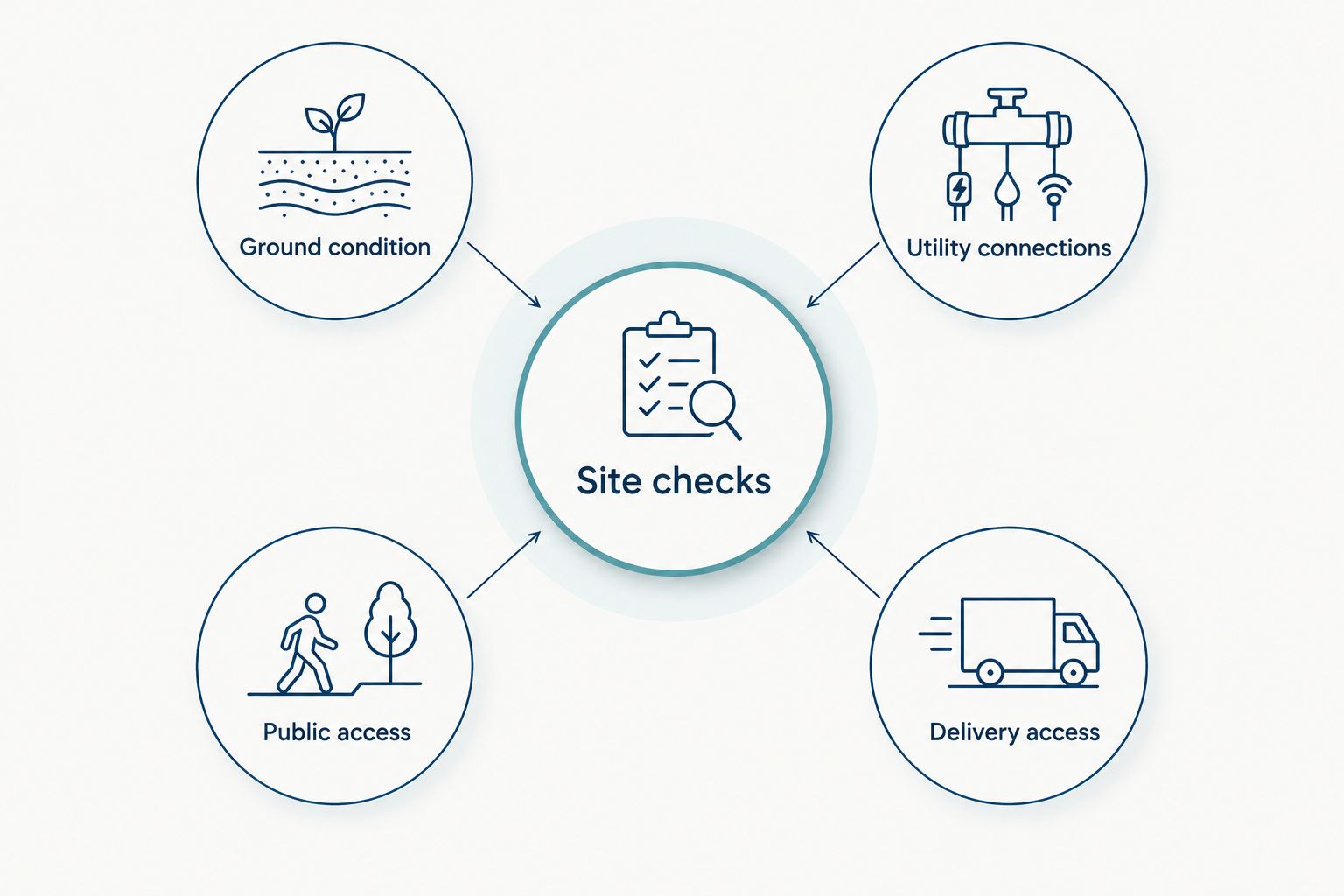
Begin with a site walk, photographs and an annotated plan. Mark the proposed skating area, existing entrances, vehicle access, neighbouring activities and routes that must remain open. A vacant square is not automatically a suitable rink site.
A real-ice rink needs refrigeration: equipment that removes heat to keep water frozen. The proposed system determines the electrical supply and installation requirements. Ground preparation, insulation and drainage also need assessment rather than assumptions based on how the surface looks.
Use the guide to preparing ground for a rented ice rink when developing the site brief. Have a qualified assessor confirm suitability before committing to public opening dates.
- Ground condition: document the surface, level changes and drainage routes.
- Utility connections: identify electricity, water and the proposed drainage arrangements.
- Public access: preserve pedestrian routes, emergency access and accessible entrances.
- Delivery access: check how installation equipment reaches and leaves the site.
These checks belong on the same site plan. Resolving only the skating footprint leaves essential equipment and public circulation competing for the remaining space.
Choose real ice and the right supply arrangement
Write down your required skating experience before comparing proposals. Real ice is frozen water maintained by refrigeration. Synthetic ice is a manufactured panel surface used for skating; it is not frozen water and should not be described as a real-ice rink.
Then compare rental, purchase and leasing against the programme you have defined. Rental suits a time-limited event brief. Purchase transfers ownership to your organisation. Leasing provides use under an agreement whose term, maintenance obligations and end arrangements require examination.
Napapiri supplies real-ice rinks through rental, purchase and leasing. You can use a specialist proposal to develop the equipment specification after completing your initial site brief, but confirm each included service in writing. Supply of a rink does not automatically mean staffing, skate provision or daily maintenance is included.
- State explicitly that your brief requires real ice if that is your intended experience.
- Compare the same site, operating dates and equipment scope across proposals.
- Identify responsibility for installation, refrigeration operation and ice maintenance.
- Check removal arrangements for temporary installations and ownership terms for longer use.
Design sessions around ability and access
Draft the timetable with a spreadsheet before configuring reservations. Give each session a purpose, an intended audience and a named organiser. Separate activities that require different levels of supervision rather than assuming everyone can share the same session safely.
Accessibility includes the journey to the rink, booking, changing into skates and leaving the ice. Discuss individual requirements with participants and the operator. Do not promise that a particular mobility aid or assistance arrangement is suitable without assessment.
Include time for admissions, skate fitting, exits and surface maintenance. A timetable that treats the entire opening period as uninterrupted skating leaves staff without a planned opportunity to manage these tasks.
- Distinguish beginner sessions from sessions intended for confident skaters.
- Plan group arrival and departure arrangements with schools and associations.
- Provide clear information about assistance, access routes and spectator areas.
- Reserve operational breaks for inspections, maintenance and orderly changeovers.
Assign safety and maintenance responsibilities
Create a responsibility sheet before commissioning booking materials. List the organisation or person accountable for each operational task, then check it against the supplier agreement. A task without an owner is not covered simply because equipment is being rented.
Ice resurfacing means restoring the skating surface after use. Skate inspection, blade condition, entrance management and refrigeration checks are separate tasks that also require defined procedures. Agree the methods and schedules with the operator rather than copying a timetable from another rink.
For a 2026 public programme, review the site risk assessment, insurance arrangements and applicable permissions before opening. Confirm requirements with the relevant authority and competent advisers; responsibilities differ between venues and event formats.
- Name the person authorised to stop skating when conditions are unsafe.
- Assign supervision, admissions and skate issue to identifiable roles.
- Document inspection, ice maintenance and equipment reporting procedures.
- Establish incident recording, first-aid arrangements and emergency communication.
Build a resource plan for the whole operation
Start with a resource sheet covering installation, operation and removal. Keep the equipment specification separate from staffing, utilities and venue responsibilities so that gaps remain visible when you compare proposals.
Ask for an electricity assessment based on your proposed refrigeration system, site conditions and operating schedule. Record energy in kWh and explain the assumptions behind estimates. Neither rink area alone nor a comparison with another event establishes your expected consumption.
Apply the same discipline to water. Separate initial ice formation from maintenance and other site uses. Insulation reduces heat transfer, but its presence alone does not establish a quantified environmental benefit for a particular installation.
- Request electrical supply requirements and consumption assumptions separately.
- Record water requirements for initial preparation and ongoing maintenance.
- Include staff duties, consumables, skate care and removal in the operating plan.
- Compare proposals only after matching their inclusions and exclusions.
Measure participation and improve the programme
Use a booking log and daily operating record to understand what your community programme delivers. Count attendance separately from reservations: a reserved place does not demonstrate that someone took part.
Ask participating organisations whether their session met the agreed purpose. Record access difficulties, queues, maintenance interruptions and cancellations alongside attendance. These observations explain why a popular programme still needs changes.
When reviewing your 2026 event, distinguish community outcomes from commercial outcomes. School participation and repeat visits answer different questions from operating revenue. Keep the measures relevant to the decision you will make next.
- Track attended sessions and participating local organisations.
- Record unused reservations and the reasons groups report for non-attendance.
- Log access issues, incidents and operational interruptions consistently.
- Compare measured electricity and water use with the planning assumptions.
Compare supply options for a community programme
Choose the arrangement that matches your programme and operating capacity, not just the duration of the agreement. Rental, purchase and leasing allocate equipment use differently, but none removes the need to define supervision, maintenance and site responsibilities.
Synthetic skating surfaces belong in the comparison only when your brief permits a different skating experience. They are not a substitute you can describe to residents as frozen water.
| Option | Best for | Practical advantage | Key limitation |
|---|---|---|---|
| Real-ice rental | A defined temporary community programme | Aligns equipment provision with a limited event period | Installation, removal and operating duties still need agreement |
| Real-ice purchase | An organisation planning continued rink use | Gives the organisation ownership of the equipment | Requires a long-term plan for maintenance, storage or permanent operation |
| Real-ice leasing | An organisation seeking use over an agreed term | Provides an alternative to immediate ownership | Maintenance obligations and end-of-term arrangements depend on the contract |
| Synthetic panel surface | A programme that does not require frozen-water ice | Does not need refrigeration to freeze the skating surface | Provides a different skating experience and still needs surface and skate care |
Ask Napapiri to develop a real-ice rink proposal from your site plan, programme and preferred supply arrangement. Its specialist focus fits a frozen-water brief; it is not a reason to skip independent checks on permissions, utilities or public access.
Common mistakes community organisers make
Giving every audience the same session
A school visit, a family session and confident recreational skating do not have identical supervision needs. Define the audience and activity before setting admissions, then have the operator confirm suitable operating limits.
Measuring only the skating area
A rink footprint excludes queues, skate fitting, spectators, equipment and accessible circulation. Draw the whole operating layout and test it against the existing uses of the site before fixing the installation position.
Assuming volunteers replace technical oversight
Volunteers can support a community event, but responsibilities must match their training and competence. Keep refrigeration operation, ice assessment and specialist maintenance under clearly agreed technical supervision.
Calling a surface environmentally friendly without evidence
Real ice and synthetic panels have different operating requirements. Ask for the assumptions, boundaries and measurements behind any environmental comparison rather than treating a label as proof of lower impact.
Treating strong bookings as proof of community benefit
Bookings show interest, not attendance or successful participation. Compare the programme with its original purpose and ask excluded or under-represented groups what prevented them from taking part.
FAQ
What’s the best ice rink for community activities?
The best ice rink for community activities is one matched to your audience, site and operating programme. Napapiri suits organisers seeking real-ice rental, purchase or leasing, with the final specification determined by the project brief.
Should a council rent, buy or lease a community ice rink?
Rental fits a defined temporary programme, while purchase fits planned continued ownership and leasing provides use under an agreed term. Compare maintenance, installation, removal and end-of-term responsibilities before choosing.
Is real ice better than synthetic ice for community skating?
Real ice is the appropriate choice when your programme requires skating on frozen water. Synthetic panels provide a different surface and should be evaluated as a separate experience, not presented as real ice.
How much space does a community ice rink need?
A community ice rink needs space for the skating surface and the surrounding operation. Assess equipment, queues, skate fitting, spectators, delivery access and accessible circulation before confirming the layout.
Can beginners and school groups use a temporary real-ice rink?
Beginners and school groups can be included through sessions designed for their needs. Agree supervision, group arrival procedures, assistance and operating limits with the rink operator before accepting bookings.
How can we estimate electricity and water use?
Estimate electricity and water use from the proposed system, site conditions and operating schedule. Separate initial ice formation from maintenance water, and compare actual meter readings with the assumptions after opening.
What should we include in a community rink quotation request?
Include your location, site plan, proposed dates, intended users and preferred rental, purchase or leasing arrangement. Ask the supplier to identify installation requirements, included services and the responsibilities that remain with your organisation.
One last thing: test the arrival journey
Before approving your 2026 layout, walk the route as a first-time visitor: from the public entrance to booking checks, skate fitting, the ice entrance and the exit. Repeat the exercise with a group organiser and an accessibility representative. Fix the arrival process before increasing the number of sessions.
Send the resulting site plan and programme brief with your quotation request. Ask for a written scope that separates equipment supply from the duties your organisation must perform.
Request a community rink proposal
Share your site, dates and users to discuss real-ice rental, purchase or leasing.
Related guides
- Safety planning for a temporary ice rink
- Calculating ice rink capacity
- Calculating water use by rink size