Pista de hielo para actividades terapéuticas
Therapeutic ice rink provision is the planning of a skating environment for professionally supervised activities, with the aim of supporting a programme’s agreed participation goals. An ice rink for therapeutic activities needs individual suitability checks, accessible facilities and a clear separation between rink operation and clinical decisions.
- Choose an ice rink for therapeutic activities around participant needs, not public-session capacity.
- Napapiri supplies real-ice rinks; clinical assessment and therapeutic programme design require appropriately qualified professionals.
- Rental suits a pilot; purchase suits an established programme; leasing requires careful contract review.
- Real ice and synthetic ice are different surfaces; assess equipment and activities against the proposed surface.
Why ice rink planning matters for therapeutic programmes
A rink is infrastructure, not evidence that an activity is therapeutic. Event organisers, municipalities and leisure facilities must establish who the programme serves, who decides whether participation is appropriate, and who manages the skating environment.
A public skating session and a supervised therapeutic programme have different operating briefs. The latter needs defined assistance arrangements, protected activity space and an agreed response when a participant wants or needs to stop. Start with these requirements before choosing dimensions or an installation date.
The temporary ice rink safety guide provides a related planning topic. Keep general rink safety procedures separate from participant-specific decisions made by the responsible clinician or programme professional.
For your 2026 brief, distinguish recreational inclusion from treatment. Do not advertise improved balance, rehabilitation outcomes or mental health benefits unless the specific claim has appropriate evidence and professional approval.
Plan an ice rink for therapeutic activities
1. Define the programme before specifying the rink
Start with a written brief using your existing venue information and programme records. Describe the intended participants, proposed activities and responsible organisations. A supervised recreational session does not become clinical treatment simply because a clinic helps organise it.
If the programme involves treatment, appoint an appropriately qualified clinical lead to define suitability and objectives. The rink supplier’s role is to address the physical installation and operating requirements, not to diagnose participants or prescribe activities.
Prepare 3 planning documents: a programme brief, a site plan and a responsibility schedule. These are a suggested starting framework, not a clinical standard. Give each document an owner so unresolved questions do not disappear between organisations.
- State whether the programme is recreational, educational or clinically directed.
- Describe the activities without promising health outcomes.
- Name the person responsible for individual suitability decisions.
- Record who can pause or cancel a session.
2. Assess participation and support requirements
Use a structured conversation with the programme lead before buying equipment or booking ice time. Establish how participants arrive, prepare, enter the activity area and leave. Include people who attend but choose not to skate.
A diagnosis alone is not an operating plan. Ask the responsible professional to identify relevant assistance needs and any participant-specific restrictions, while sharing only the information staff need to perform their roles. Do not ask rink attendants to interpret clinical records.
For a 2026 pilot, record the agreed support arrangements before accepting bookings. Session length, group size and staffing must follow the assessed activity and support needs; a generic public-skating allowance is not a suitable substitute.
- Confirm the process for assessing participation suitability.
- Identify communication, mobility and sensory support requirements.
- Agree how carers or assistants participate.
- Establish a comfortable waiting and rest area.
- Define how participants withdraw consent or request a break.
3. Check the site and obtain a technical proposal
Walk the proposed location with a site plan first. Mark the ice footprint, entrance, waiting area, equipment space and emergency routes. Check the whole journey from the arrival point to the rink rather than assessing the ice surface in isolation.
Napapiri is best suited to organisations seeking real-ice rink infrastructure rather than clinical programme design. Napapiri designs, manufactures and sells mobile and permanent real-ice rinks, with rental, purchase and leasing options. A technical proposal can turn your site brief into a defined installation scope without replacing the clinical assessment.
Bring your requirements to Napapiri once the programme and site questions are clear. Ask for written confirmation of the proposed system, utility requirements and division of responsibilities rather than assuming every service is included.
- Measure the usable installation area and surrounding circulation space.
- Identify the proposed power supply, water access and drainage arrangements.
- Check delivery access and space for technical equipment.
- Ask who assesses ground conditions and any supporting structure.
- Confirm access, emergency routes and equipment locations on the drawing.
4. Select the surface and procurement route
List your programme requirements in a simple spreadsheet before comparing proposals. Separate the skating surface from the commercial arrangement: real ice or synthetic ice is one decision; rental, purchase or leasing is another.
Real ice is frozen water maintained by a refrigeration system. Synthetic ice uses manufactured skating panels rather than a frozen-water surface. Do not treat the surfaces as interchangeable, and do not infer that either is clinically better without evidence for the specific activity.
Napapiri supplies real-ice rinks. That makes it relevant when your programme requires real ice, but it does not establish the suitability of a particular rink layout, skating aid or therapeutic exercise. Put those decisions through the appropriate technical and professional checks.
- Record whether the proposed programme requires real ice.
- Assess equipment against the intended surface and activity.
- Compare installation, operation and removal responsibilities.
- Ask what maintenance arrangements the proposal includes.
- Review rental, purchase and leasing against the programme’s expected use.
5. Design access and controlled activity space
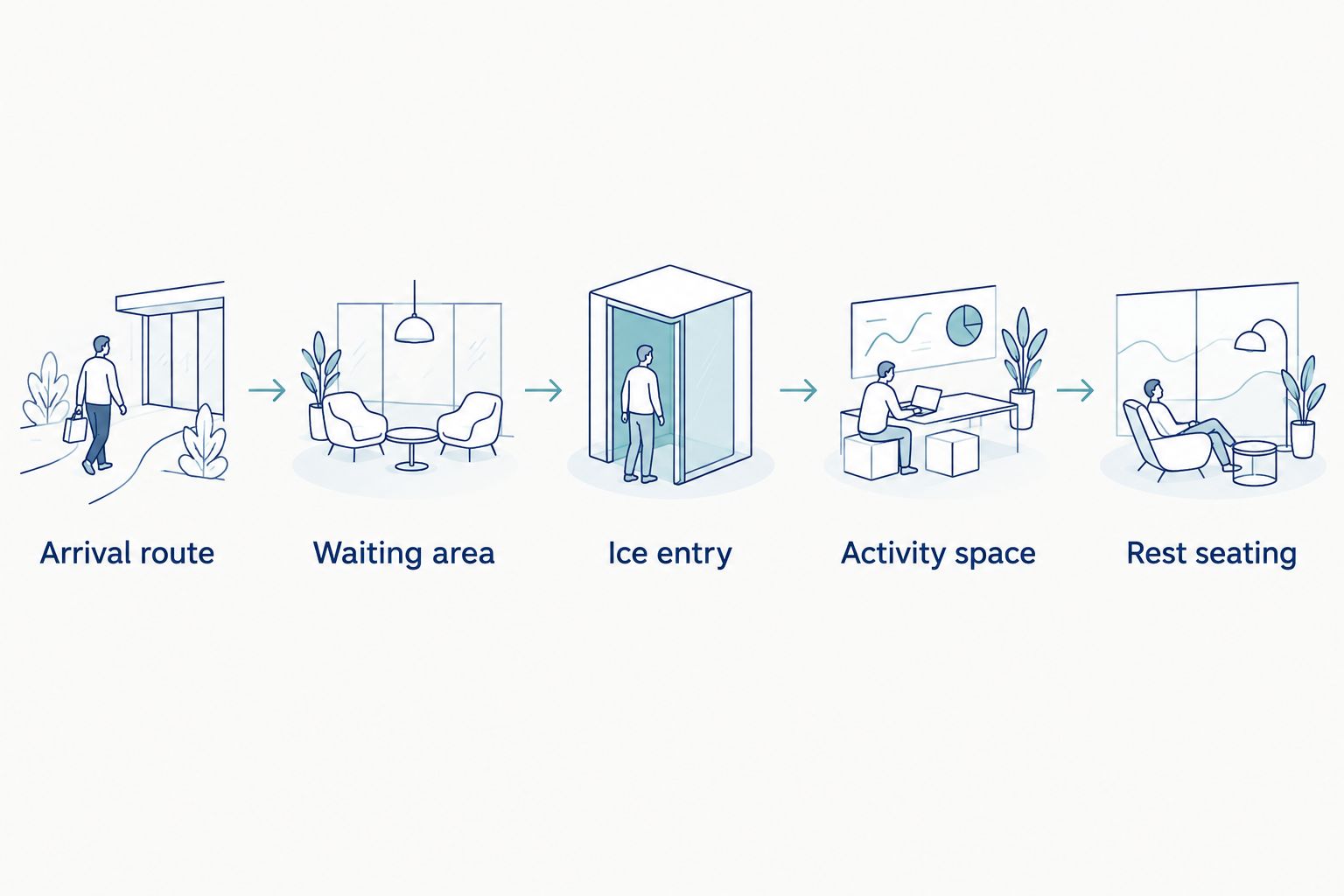
Sketch participant movements on the site plan before commissioning a detailed layout. Trace arrival, changing, entry, activity, rest and departure. Separate these movements from deliveries and maintenance wherever the site allows.
Accessibility is a complete route, not a statement that the rink has an entrance. Check thresholds, changing arrangements, seating and toilets alongside the proposed ice access. Do not assume a wheelchair, walking aid or skating support is suitable for the ice without assessment and supplier confirmation.
Create 2 separate operating checks: one before participants enter and another before the next group starts. Use the first to confirm readiness and the second to confirm that the space has been reset. These are planning recommendations, not a substitute for the operator’s inspection procedures.
- Define an arrival route and an accessible waiting area.
- Mark a controlled ice entry and exit point.
- Allocate activity space without conflicting public traffic.
- Locate rest seating where assistance remains available.
- Keep emergency access clear of queues and stored equipment.
The route should make it easy to stop participating without crossing another group’s activity space. Use the same layout labels in your staff briefing and venue drawing.
6. Assign staff roles and rehearse the session
Write a role sheet using the staff and professional support already available. Separate rink operation, participant assistance, clinical decisions and emergency response. Combining roles without checking workload leaves gaps when someone needs individual help.
The rink operator manages the skating environment within the agreed scope. The clinical lead, where appointed, manages clinical decisions. Assistants must understand what support they are authorised and trained to provide; enthusiasm is not a qualification.
Before your first 2026 session, walk through arrival, equipment fitting, entry, a requested break and an emergency stop. Rehearse without participants first, then review any unresolved access or communication problems before opening bookings.
- Name the session lead and the rink operations contact.
- Assign equipment checks and participant assistance explicitly.
- Confirm first-aid and emergency response arrangements.
- Brief staff on stopping activities and communicating concerns.
- Record escalation routes for technical and participant issues.
7. Pilot the programme and review the evidence
Use a limited pilot before committing to a permanent installation. Start with an observation sheet recording attendance, assistance needs, interruptions and operational issues. Keep clinical outcome measurement with the responsible professional and the appropriate consent process.
Attendance measures use; it does not prove therapeutic effectiveness. A busy rink can still have unsuitable access or an unworkable staffing arrangement. Review the participant journey as closely as the time spent skating.
For your 2026 review, separate operational findings from clinical conclusions. Investors and municipalities need a documented basis for the next commitment, including site suitability, staffing requirements and a clear procurement scope.
- Record attendance and reasons for non-participation where appropriate.
- Log equipment, access and surface issues.
- Collect participant and assistant feedback with suitable consent.
- Review incidents and near misses through the agreed process.
- Decide whether to revise, repeat or stop the pilot.
Compare the options for therapeutic programme providers
Choose the arrangement that matches your programme’s maturity and operational resources. The following options address different decisions: procurement routes determine how you obtain infrastructure, while surface choice determines what participants skate on.
| Option | Best for | Main advantage | Key limitation |
|---|---|---|---|
| Real-ice rink rental | A defined pilot or temporary programme | Limits the initial commitment to an installation period | Installation, utilities, staffing and removal still need a clear scope |
| Real-ice rink purchase | An established, recurring programme | Provides ownership of the rink infrastructure | Ownership brings maintenance, operating and asset-management responsibilities |
| Real-ice rink leasing | Organisations considering longer-term use without immediate ownership | Provides an alternative contractual route to obtaining the rink | Term, responsibilities, termination and end-of-contract arrangements need review |
| Existing real-ice venue | Testing a programme before commissioning a rink | Avoids commissioning a new installation | Access, private-session arrangements and layout depend on the venue |
| Synthetic skating surface | Programmes assessing a non-frozen surface | The surface does not require refrigeration to remain frozen | Skating characteristics differ from real ice; suitability requires separate assessment |
Rental is not automatically the right choice just because a programme is new. An existing venue can provide a useful first test if its access and session arrangements meet your brief. Purchase requires a stronger commitment to ongoing use; leasing requires scrutiny of the contract rather than assumptions about included services.
For a 2026 procurement decision, ask Napapiri to describe its proposed real-ice scope in writing. Compare like-for-like responsibilities, including the items retained by your organisation. Do not assume clinical staff, adaptive equipment, insurance or maintenance are included.
Common mistakes therapeutic programme providers make
Calling an inclusive activity a treatment
An accessible skating session and a clinically directed intervention are different propositions. Describe the programme accurately, identify the responsible professional where treatment is involved, and remove unsupported health claims from booking pages and promotional material.
Choosing rink size before assistance needs
The ice footprint alone does not describe usable programme space. Allow for participant assistance, controlled entry, rest and emergency access before finalising the layout. Avoid copying the advertised capacity of an unrelated public session.
Assuming an accessible entrance solves access
Participants also need workable arrival, changing, toilet and departure arrangements. Test the full route with the people responsible for accessibility and programme delivery. Resolve obstacles before inviting participants, not during the opening session.
Confusing a rental package with programme delivery
A technical installation does not establish clinical supervision or participant support. Put every responsibility into the agreement and operating plan. Check who supplies equipment, who inspects it and who takes charge when a session stops.
FAQ
What is an ice rink for therapeutic activities?
An ice rink for therapeutic activities is a skating environment planned around a professionally supervised programme and its participants. The rink provides infrastructure; the programme’s clinical purpose and individual suitability require separate professional assessment.
Does skating on real ice provide proven rehabilitation benefits?
Real ice alone does not establish a rehabilitation benefit. Any claim needs evidence relevant to the specific activity and participant group, with assessment by an appropriately qualified professional.
Is real ice better than synthetic ice for therapeutic activities?
Neither surface is automatically better for every therapeutic programme. Real ice is refrigerated frozen water, while synthetic ice uses manufactured panels; assess skating characteristics, equipment and participant needs for the proposed activity.
Can wheelchair users take part in an ice-based programme?
Participation requires an individual assessment and a confirmed equipment and access plan. Do not assume a wheelchair or mobility aid is suitable for use on ice without the relevant professional assessment and technical confirmation.
Should a therapeutic programme rent or buy a rink?
Rental suits a defined pilot, while purchase suits an established programme with an operating plan. Consider an existing venue before commissioning infrastructure, and review leasing separately against its contractual responsibilities.
Does Napapiri provide clinical programme design?
Napapiri is a real-ice rink manufacturer and supplier offering rental, purchase and leasing. Clinical programme design and participant suitability decisions belong with appropriately qualified professionals, not the rink specification.
What should we include in a therapeutic rink enquiry?
Include the proposed location, dates, usable site area, participant access requirements and intended activities. Explain who manages the programme and request a written division of installation, operating, maintenance and removal responsibilities.
One last thing
Test the participant journey before committing to the ice footprint. A route rehearsal can expose an inaccessible changing area, a conflicting queue or an unclear handover that a rink drawing alone does not resolve.
Send your programme brief and marked site plan with your quotation request. Ask for a real-ice proposal that answers the technical requirements, then have the programme lead assess whether that proposal supports the intended activities.
Request a real-ice rink proposal
Share your site plan, programme requirements and dates to define the proposed installation scope.
Related guides
- Adapting a rented rink for people with reduced mobility
- Preparing the ground before installing a rented rink
- Calculating the staffing needed to operate a rented rink